
What Is Full HD?
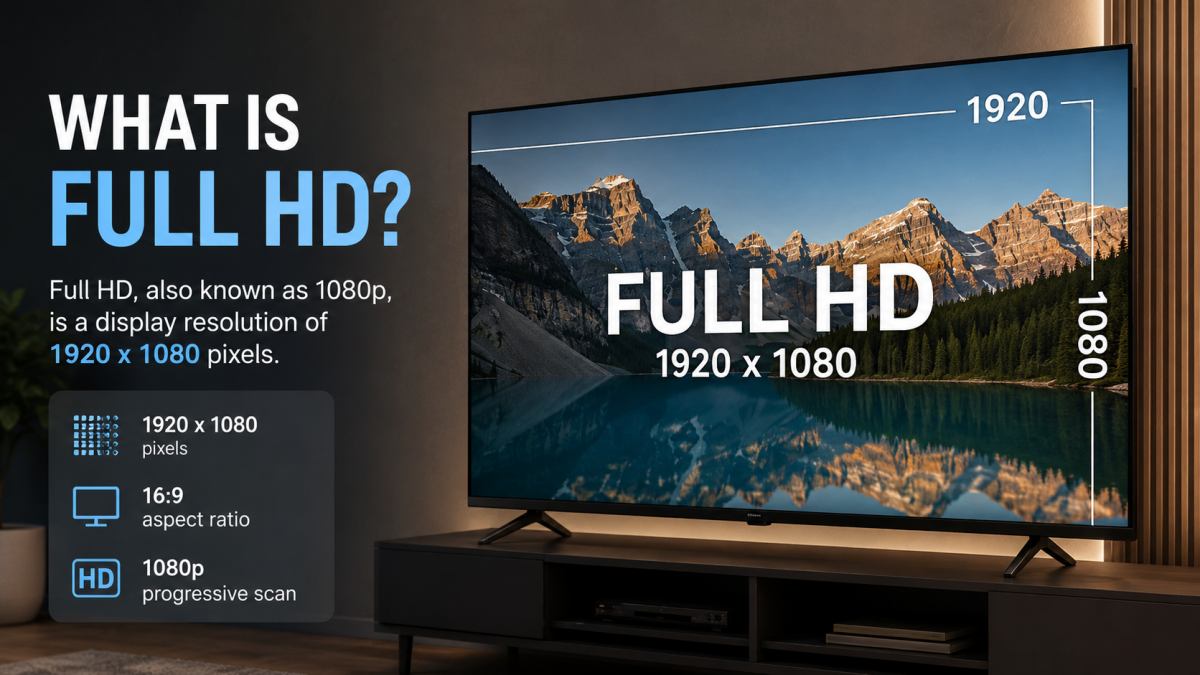
Full HD, also known as 1080p, is a display resolution of 1,920 × 1,080 pixels. For many years, Full HD was the standard resolution for televisions, computer monitors, laptops, and streaming content. Even today, Full HD remains a popular choice for budget-friendly TVs, monitors, and smaller screens.
If you’ve ever wondered what Full HD means and how it compares to modern technologies like 4K Ultra HD, this guide will explain everything you need to know.
What Does Full HD Mean?
The term Full HD refers to a display resolution of 1,920 pixels horizontally and 1,080 pixels vertically. This results in approximately 2.1 million pixels displayed on the screen.
Full HD is often called 1080p because the image contains 1,080 horizontal lines displayed progressively rather than interlaced.
What Is the Resolution of Full HD?
A Full HD display has a resolution of:
- 1,920 × 1,080 pixels
- Approximately 2.1 million pixels
- 16:9 widescreen aspect ratio
The 16:9 aspect ratio has become the standard format for television broadcasts, streaming services, gaming consoles, and computer monitors.
Full HD vs HD Ready
Many people confuse Full HD with HD Ready, but there is a significant difference between the two.
| Resolution Type | Pixel Resolution |
|---|---|
| HD Ready | 1,280 × 720 |
| Full HD | 1,920 × 1,080 |
Full HD contains more than twice the number of pixels found in HD Ready displays, resulting in a noticeably sharper image.
Full HD vs 4K Ultra HD
Today, most new televisions feature 4K Ultra HD resolution. A 4K display contains four times as many pixels as a Full HD display.
| Resolution | Pixels |
|---|---|
| Full HD | 1,920 × 1,080 |
| 4K Ultra HD | 3,840 × 2,160 |
Because of the higher pixel count, 4K televisions provide greater detail, sharper images, and improved clarity on larger screens.
However, Full HD still looks excellent on smaller displays and when viewed from normal viewing distances.
Advantages of Full HD
- Lower cost than 4K displays
- Reduced bandwidth requirements for streaming
- Excellent image quality on smaller screens
- Widely supported by streaming services and devices
- Ideal for budget-conscious buyers
Best Uses for Full HD Displays
Full HD remains a practical choice in several situations.
- Bedroom televisions
- Kitchen TVs
- Computer monitors
- Budget gaming setups
- Streaming on smaller screens
- Office displays
For screen sizes under 40 inches, many viewers may find it difficult to notice a major difference between Full HD and 4K content.
Is Full HD Still Good in 2026?
Yes. While 4K has become the standard resolution for most new televisions, Full HD remains perfectly suitable for many users. Streaming services continue to support 1080p content, and many laptops, monitors, and budget TVs still use Full HD displays.
If you’re purchasing a television larger than 55 inches, a 4K model is usually the better choice. However, for smaller screens and budget-conscious buyers, Full HD continues to offer excellent value.
Should You Buy a Full HD TV?
A Full HD TV can still be a smart purchase if you’re looking for an affordable television for a bedroom, guest room, dorm room, or office. The picture quality remains impressive, and Full HD content is widely available.
For larger screens, home theater setups, and the best possible viewing experience, a 4K TV is generally the recommended option. However, Full HD remains a reliable and cost-effective display technology that continues to meet the needs of millions of viewers worldwide.
Want to learn more about modern TV technology? Check out our guides on Smart TVs, 4K Ultra HD, OLED TVs, and QLED TVs.