
If you’ve been shopping for a modern television, you’ve probably come across the term QLED. It appears on TVs from Samsung, TCL, Hisense, and other major manufacturers, often alongside terms such as 4K, HDR, Mini LED, and Quantum Dot.
But what is QLED actually doing inside the television?
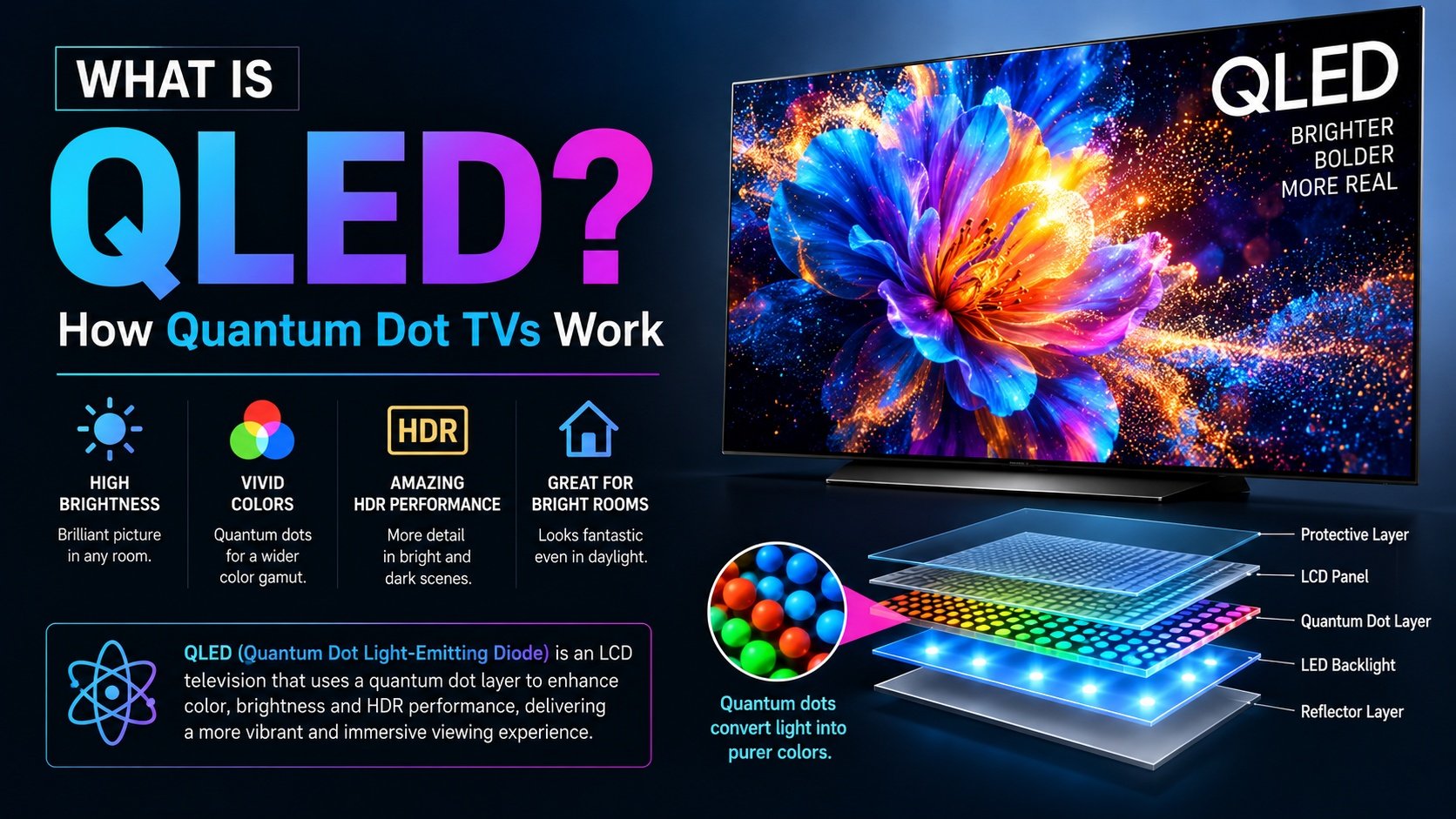
QLED is not a completely different type of display from LED/LCD. Instead, it is an LCD television that uses a layer of Quantum Dots to improve the quality of the light used to create the image. The result can be higher brightness, richer colors, and stronger color performance, particularly in HDR content.
Understanding this distinction is important because QLED is often presented as if it were a direct alternative to OLED. In reality, the two technologies work in fundamentally different ways.
What Does QLED Stand For?
QLED stands for Quantum Dot Light-Emitting Diode.
In a typical consumer QLED television, the display is still based on an LCD panel and an LED backlight. The important addition is a layer containing microscopic semiconductor particles called quantum dots.
These quantum dots interact with light from the TV’s backlight and help produce purer, more precisely controlled colors.
The easiest way to think about it is this: the LCD panel creates the image, the LED backlight provides the light, and the quantum-dot layer helps make that light more useful for producing bright and accurate colors.
What Are Quantum Dots?
Quantum dots are extremely small semiconductor nanocrystals. Their optical properties depend partly on their size, which allows manufacturers to engineer them to emit very specific wavelengths of light.
In a QLED television, quantum dots are used to improve the quality of the light reaching the LCD panel.
Rather than simply filtering a broad light source and throwing away a significant amount of unwanted light, quantum-dot technology can convert incoming light into narrower and more useful portions of the color spectrum.
This helps a QLED television produce highly saturated colors while maintaining high brightness.
How Does a QLED TV Work?
A modern QLED television contains several layers working together. The exact construction varies between manufacturers and models, but the basic concept is straightforward.
- LED backlight: Provides the light used to illuminate the display.
- Quantum-dot layer: Converts part of the incoming light into more precisely controlled wavelengths.
- LCD layer: Controls how much light passes through each part of the image.
- Color and optical layers: Help produce the final red, green, and blue components of the image.
- Display electronics: Control the pixels and process the incoming video signal.
The important point is that QLED remains an LCD-based display technology. The quantum dots improve the light and color performance, but the TV still relies on a backlight and an LCD panel.
Why Do QLED TVs Look So Bright?
Brightness is one of the areas where high-quality QLED televisions can be particularly impressive.
Because QLED TVs use an LED backlight, manufacturers can design them to produce very high levels of luminance. The quantum-dot layer can then help maintain strong color saturation as brightness increases.
This combination is particularly useful for HDR, where the television needs to reproduce both intense highlights and highly saturated colors.
A bright reflection on water, sunlight shining through a window, neon lighting, or a fireball in an action scene can benefit from the combination of high brightness and strong color volume.
What Is Color Volume?
Color volume is an important concept that is often overlooked when comparing televisions.
A TV may be capable of producing a wide range of colors at moderate brightness, but maintaining those colors as the image becomes brighter is another challenge.
High-quality QLED displays are designed to maintain strong color saturation at high brightness levels. This can make HDR content look particularly vibrant, especially in bright viewing environments.
This is one of the reasons QLED televisions can be an excellent choice for rooms with lots of daylight.
QLED vs Traditional LED TVs
QLED and conventional LED TVs both use LCD panels and LED backlights. The major difference is the quantum-dot layer.
| Feature | Traditional LED/LCD | QLED |
|---|---|---|
| LCD panel | Yes | Yes |
| LED backlight | Yes | Yes |
| Quantum dots | Usually no | Yes |
| High brightness potential | Varies | Generally excellent |
| Wide color gamut | Varies | Generally excellent |
The quality of the individual television still matters enormously. A cheap QLED TV is not automatically better than every conventional LED TV, and the term QLED does not tell you everything about the panel, backlight, local dimming system, or image processor.
QLED vs OLED: What’s the Difference?
QLED and OLED may sound similar, but their underlying technologies are very different.
A QLED television uses an LCD panel and a separate LED backlight. An OLED television uses self-emissive pixels, meaning each pixel can produce its own light.
This difference has a major effect on picture quality.
| Feature | QLED | OLED |
|---|---|---|
| Backlight | LED | Not required |
| Self-emissive pixels | No | Yes |
| Black level | Depends on backlight and local dimming | Excellent |
| Peak brightness | Often very high | Improved significantly in modern models |
| Viewing angles | Varies by panel | Generally excellent |
| Burn-in considerations | Generally lower | Requires consideration with prolonged static content |
OLED has an inherent advantage in black-level precision because individual pixels can turn completely off. QLED, on the other hand, can offer exceptional brightness and strong color performance.
There is no universal winner. The better choice depends on the room, content, viewing habits, and specific TV model.
QLED vs Mini LED: An Important Difference
This is where TV terminology can become confusing.
QLED and Mini LED are not mutually exclusive technologies.
QLED describes the use of quantum-dot technology to improve color performance, while Mini LED describes the type of backlight used behind the LCD panel.
A television can therefore be both QLED and Mini LED.
Mini LED uses a much larger number of smaller LEDs in the backlight. This allows manufacturers to create more precise local dimming systems with many independently controlled zones.
The combination of quantum dots and Mini LED can therefore produce a television that is both extremely bright and capable of much better contrast than a conventional edge-lit LCD TV.
What Is Neo QLED?
Neo QLED is a term most closely associated with Samsung’s premium QLED televisions. In general, Neo QLED combines quantum-dot technology with a Mini LED backlight.
The idea is simple: quantum dots help with color, while the Mini LED backlight provides much more precise control over brightness.
This can improve black levels, HDR performance, and contrast compared with simpler QLED designs.
However, the exact performance depends on the TV’s local dimming system, panel characteristics, image processor, and software. The name alone does not guarantee identical performance across different models.
Why QLED Can Be Great for Bright Rooms
Your viewing environment matters more than many TV buyers realize.
If your living room has large windows, strong daylight, or lots of artificial lighting, a very bright television can provide a more satisfying viewing experience.
QLED technology is particularly well suited to these conditions because many QLED models can produce high brightness while maintaining strong color saturation.
This makes QLED an attractive option for sports, daytime television, news, streaming, and HDR content in bright rooms.
Are QLED TVs Good for Gaming?
Yes. Modern QLED TVs can be excellent gaming displays, particularly when they combine a high refresh rate with HDMI 2.1 and advanced gaming features.
Depending on the model, look for:
- 4K resolution
- 120Hz or higher refresh rate
- HDMI 2.1
- Variable Refresh Rate (VRR)
- Auto Low Latency Mode (ALLM)
- Low input lag
- FreeSync or other adaptive-sync technologies
High-end QLED and Mini LED TVs can be particularly impressive for gaming because they combine high brightness with strong HDR performance.
Does QLED Mean 4K?
No. QLED and 4K describe different aspects of a television.
QLED describes the display technology and the use of quantum dots.
4K describes the screen resolution, normally 3,840 × 2,160 pixels in consumer televisions.
A TV can therefore be both QLED and 4K, but the terms do not mean the same thing.
Does QLED Have Perfect Blacks?
Standard QLED televisions cannot achieve the same pixel-level black control as OLED because the LCD panel still depends on a separate backlight.
However, advanced QLED televisions with full-array local dimming or Mini LED backlights can dramatically improve contrast.
The best Mini LED QLED displays can control thousands of small light sources across many zones, reducing unwanted light around bright objects in dark scenes.
Even so, some blooming can still occur because each dimming zone contains multiple LCD pixels, whereas OLED controls light at the individual pixel level.
Who Should Buy a QLED TV?
QLED can be an excellent choice if you:
- Watch TV in a bright room
- Want very high brightness
- Watch a lot of sports
- Enjoy colorful HDR content
- Want a large screen
- Play games on a modern console or PC
- Prefer an LCD-based display
- Want to avoid the specific burn-in considerations associated with OLED
For many living rooms, a good QLED or Mini LED QLED television offers an excellent balance between brightness, color, HDR performance, and price.
How to Choose a Good QLED TV
Don’t choose a QLED television based on the QLED label alone. Two QLED TVs can have dramatically different performance.
When comparing models, pay attention to:
- Peak and sustained brightness
- Native refresh rate
- Local dimming capability
- Number and quality of dimming zones
- HDR format support
- Color volume
- Viewing angles
- HDMI 2.1 features
- Input lag
- Image processing
For a more direct look at available models, explore our QLED TVs category.
Should You Choose a QLED TV?
QLED is best understood as an advanced form of LCD television that uses quantum dots to improve the quality and efficiency of the light used to create the picture.
Its biggest strengths are high brightness, strong color performance, and excellent HDR potential. When QLED is combined with a sophisticated Mini LED backlight and effective local dimming, it can deliver an impressive combination of brightness and contrast.
OLED still has an important advantage when it comes to pixel-level black control, but QLED can be a better fit for bright rooms, high-brightness HDR viewing, and buyers who want a powerful large-screen television.
The most important lesson is simple: don’t judge a TV by the QLED label alone. The backlight, local dimming system, panel quality, processing, brightness, and gaming features all matter.
When those elements are well executed, a QLED TV can deliver an exceptionally bright, colorful, and immersive home entertainment experience.